
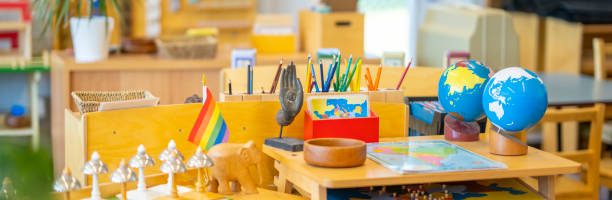
If you’ve never spent time inside a Montessori classroom, the rhythm of the day can be a mystery. It doesn’t run on bells, worksheets, and whole-class lessons the way many of us remember school. Instead, it flows in a way that’s calm, purposeful, and surprisingly self-directed. Here’s a walk-through of what a typical day actually looks like, from arrival to pickup.
Arrival and Settling In
The day usually begins gently. Children arrive and are greeted warmly, often by name, and take responsibility for their own transition into the room. They hang up their coats, put away their belongings, and change into indoor shoes if the classroom uses them.
These small routines might seem minor, but they matter, according to Creative World of Montessori. From the very first minutes of the day, children are practicing independence and learning that they are capable of taking care of themselves and their space.
This process is intentional and unhurried. Guides do not rush children through arrival, even on busy mornings. A child who needs an extra minute to say goodbye to a parent or settle their thoughts is given that time. This sets the tone for everything that follows. Children learn that the classroom is a place where they are trusted to manage themselves, and that trust builds a quiet confidence that carries through the rest of the day.
The Work Cycle
The heart of a Montessori morning is the work cycle, often a long, uninterrupted block of two to three hours. This is where the real magic happens, and it looks very different from a traditional schedule broken into short, teacher-led periods.
During the work cycle, children choose their own activities from the shelves. One child might be tracing sandpaper letters, another building with the pink tower, another carefully pouring water between small pitchers, and another working through a math material with beads. The room hums with quiet, focused activity.
Because the block is long and unbroken, children have the freedom to settle deeply into their work. They can repeat an activity as many times as they like, follow a project through to completion, and reach that state of deep concentration that shorter periods so often interrupt.
This uninterrupted stretch of time is one of the most distinct features of a Montessori classroom. Rather than moving from subject to subject on a fixed clock, children are allowed to fully absorb themselves in a task until they feel finished with it. A child working with a puzzle map of the continents might spend forty minutes with it one day and return to it again the next, refining their understanding a little more each time. This kind of repetition is not seen as falling behind. It is seen as the natural process of mastery.
Individual and Small-Group Lessons
Throughout the work cycle, the teacher, or guide, moves quietly around the room. Rather than teaching the whole class at once, they give brief lessons to individual children or small groups, introducing a new material or concept exactly when a child is ready for it.
A lesson might last only a few minutes. The guide demonstrates how to use a material, then steps back and lets the child explore and practice it independently. This one-on-one attention means each child gets exactly what they need, when they need it, without waiting for the rest of the class or being pushed ahead too soon.
Guides spend years observing how children learn best, and that observation shapes every lesson they give. They watch for readiness rather than following a fixed timeline, which means two children of the same age might be working on entirely different materials at the same moment. This individualized pacing is part of what allows Montessori classrooms to serve such a wide range of learners within a single room.
Practical Life and Grace and Courtesy
Woven throughout the morning are what Montessori calls practical life activities: pouring, spooning, buttoning, sweeping, watering plants, preparing a snack. These everyday tasks build coordination, concentration, and confidence, and they give children a real sense of contributing to their classroom community.
Alongside these are lessons in grace and courtesy, the small social skills of daily life. Children learn how to greet a visitor, wait for a turn, ask for help, and clean up after themselves. Over time these become second nature rather than rules imposed from the outside.
These lessons are often the first activities a young child encounters in the classroom, and they carry importance well beyond the task itself. Learning to carefully carry a tray of pitchers without spilling teaches focus and body control. Learning to wait patiently for a turn with a popular material teaches patience and respect for others. These are the building blocks of the social and emotional skills that support a child through the rest of their education and life.
Snack and Free Movement
Snack time in a Montessori classroom is often flexible rather than a single scheduled break. Children may visit a snack table when they feel hungry, serve themselves, eat, and clean up on their own before returning to their work. It’s one more small opportunity for independence and self-awareness.
Throughout the day, children are also free to move. There’s no expectation that everyone stays glued to a desk. A child can work on a mat on the floor, at a table, standing at a shelf, or wherever they focus best.
This freedom of movement reflects a deeper understanding of how young children learn. Sitting still for long stretches is not natural for most children, and forcing it often works against concentration rather than supporting it. By allowing children to choose their own working position and pace, the classroom supports the kind of focus that comes naturally rather than one that is forced.
Outdoor Time
Time outdoors is treated as an important part of learning, not just a break from it. Children explore nature, move their bodies, garden, and play. Fresh air and physical activity support the same focus and calm that carry back into the classroom.
Outdoor time often includes purposeful activities of its own, such as tending a garden bed, observing insects, or caring for plants. These experiences connect directly to lessons happening inside the classroom, helping children see the natural world as something to study closely rather than simply enjoy from a distance.
Coming Together as a Group
Many classrooms gather as a full group at some point in the day, often on a line or circle, for a shared activity. This might be a song, a story, a movement game, or a discussion. It’s a chance to build community and belonging, balancing all the independent work with a sense of being part of something together.
These group moments give children a chance to practice being part of a larger community, a skill that is different from the independent focus of the work cycle. They also give guides an opportunity to introduce ideas or stories that spark curiosity the children might pursue further during their individual work time.
Winding Down and Departure
As the day comes to a close, children take part in tidying the room, returning materials neatly to the shelves so everything is ready for tomorrow. Caring for the environment is simply part of the rhythm, not a chore tacked on at the end.
Then, just as they arrived, children gather their belongings and prepare to leave, having spent a day that looked less like being taught and more like genuinely learning how to learn.
The Bigger Picture
What ties the whole day together is a quiet trust in the child. The structure is there, carefully prepared and consistent, but within it children are given real freedom to choose, explore, and grow at their own pace. That balance of freedom and structure is what makes a Montessori day feel so different, and so effective.
The best way to understand it is to see it for yourself. Watching children move purposefully through their morning tends to make the whole philosophy click. If you’re in the Beavercreek area, the team at Creative World of Montessori is always happy to welcome families in for a visit and show you what a typical day looks like up close.
Creative World of Montessori
1481 N Fairfield Rd B
Beavercreek, OH 45432
(866) 866-7339


Get 4 Free Sample Chapters of the Key To Study Book
Get access to advanced training, and a selection of free apps to train your reading speed and visual memory