
Most students try to improve their learning by reading faster or taking better notes. Very few realize that the real bottleneck is how information is encoded in the brain. This is where visualization and creative markers become powerful.
In The Key to Study Skills (2nd Edition): Simple Strategies to Double Your Reading, Memory, and Focus, visualization is not treated as imagination for its own sake, but as a structured cognitive tool. The book reveals how turning paragraphs into visual markers, linking them intelligently, and adding just enough detail can dramatically increase comprehension, retention, and reading speed, without overload.
This article explains how markers work, why creativity matters, how to train visualization properly, and how small details make a big difference. At the end, you’ll also learn how to take this skill further through structured training.
Understanding Markers: The Foundation of Visual Learning
Most written texts are organized into paragraphs, and each paragraph usually revolves around one main idea. That idea can be represented by a marker, a compact mental representation of meaning.
A marker is not a summary and not a list of keywords. It is a visual anchor that captures the core theme of a paragraph.
The marker process follows a simple sequence:
- Analyze the text
- Identify key ideas
- Convert them into visual markers
- Place those markers into structured mental compartments
- Link them together meaningfully
This process allows the brain to work with images instead of raw words. Since the brain processes visuals far more efficiently than text, markers dramatically reduce cognitive load while increasing retention.
Importantly, a paragraph should not generate many markers. In most cases, two markers per paragraph are sufficient.
Visualizing Markers Using Mental Structures
Once markers are identified, they must be placed into a structure. Random images without organization quickly collapse.
A practical method is to use mental compartments, similar to shelves or storage units. Each marker occupies a defined location, and related markers are placed nearby.
You can visualize these structures as:
- Simple grids or chunks
- Shelves on a wall
- Rooms inside a memory palace
What matters is not the structure itself, but consistency. When markers are placed in predictable locations, recall becomes effortless.
The full memorization loop looks like this:
- Text → Marker
- Marker → Structure
- Structure → Memory
Over time, this process becomes automatic.
Markers vs. Details: Avoiding Cognitive Overload
One of the most common mistakes in speedreading and memory training is over-marking.
Markers represent ideas, while details make those ideas memorable. Too many markers slow down reading. Too many details confuse.
The optimal balance is:
- ~2 markers per paragraph
- ~5 details per marker
Details should always be supported by the text, not invented randomly. Their role is to make each marker distinct, not complicated.
Details may include:
- Size or color based on importance
- Texture based on material
- Motion or animation
- Familiar vs. exotic characteristics
If more than five details are needed, it is better to create an auxiliary marker rather than overload the original one.
Two Types of Markers: Logical and Creative
Not all information should be memorized the same way. The book distinguishes between logical visual markers and creative visual markers, each serving a different purpose.
Logical Visual Markers (Convergent Thinking)
Logical markers are used when you understand the material. They arise naturally from comprehension.
A logical marker represents something you have learned and can reason about. To verify a logical marker, ask:
- Is this expected or surprising?
- Does it connect to existing knowledge?
- Can it lead to action or application?
At a higher level, logical markers can become templates, such as:
- Cause-and-effect chains
- Hierarchies
- Mind maps
- Abstract frameworks
These markers preserve structure and meaning.
Creative Visual Markers (Divergent Thinking)
Creative markers are needed when analysis is difficult or impossible, such as:
- Foreign words
- Names
- Dates
- Abstract terminology
Here, imagination replaces logic. Objects may morph, collide, exaggerate, or transform rapidly. These fast animations act like visual stories compressed into milliseconds.
Strong creative markers:
- Link objects clearly
- Are unique but reproducible
- Evoke strong emotion (surprise, humor, discomfort)
Creativity alone is not enough. Uncontrolled randomness is not creativity; it must still point back to meaning.
The Etymology Method: Precision Without Guesswork
Rather than inventing markers from scratch, the etymology method uses real linguistic roots to build accurate imagery.
By understanding a word’s origin, markers become:
- More precise
- Easier to recall
- Less likely to cause confusion
The process follows clear steps:
- Look up the word’s etymology
- Break it into meaningful roots
- Associate each root with a vivid image
- Rebuild the definition logically
- Encode it creatively with accuracy
This method is especially powerful for:
- Scientific definitions
- Academic vocabulary
- Technical terminology
Strong markers must be distinct. Words that look or feel similar require different imagery; recall becomes unreliable.
Training Visualization: A Learnable Skill
Visualization is not a talent you either have or lack. It is a trainable cognitive skill.
Training begins with simple exercises and gradually increases in complexity:
- Reconstructing photographs
- Rotating physical objects mentally
- Expanding focus from points to scenes
- Recalling random online images
Each level improves both visual clarity and mental focus.
Some learners experience challenges:
- If images do not appear, processing may be subliminal rather than visual
- If images are too vivid, limiting detail improves speed
Both extremes are normal and manageable. Visualization adapts to personal cognitive style.
Playfulness: The Missing Ingredient in Fast Learning
High-performance learners are often disciplined and serious. Ironically, this mindset can block creative marker formation.
Effective marker creation requires:
- Letting go of perfectionism
- Accepting absurd or silly imagery
- Allowing free association
At high reading speeds, markers cannot be polished. They must be fast, imperfect, and functional.
Playfulness is not a weakness. It is a performance accelerator.
Little Details That Make Markers Stick
Markers become powerful when they are specific. Specificity comes from details.
Details can encode:
- Emotional tone
- Importance
- Context
- Relationships between ideas
Advanced learners reuse domain knowledge, embedding familiar concepts inside new markers. This allows parallel processing and faster comprehension.
When texts are dense, learners do not add markers endlessly; they enrich existing ones.
Analogies, Exaggeration, and Structured Creativity
Analogies help bridge unfamiliar ideas with known ones. They work by mapping function, not appearance.
Markers can be enhanced using:
- Direct analogies
- Fantasy analogies
- Remote or surprising analogies
- Personal or embodied perspectives
Tools like Osborn’s Checklist systematically stimulate creative variation through modification, substitution, rearrangement, and exaggeration.
Exaggeration works because it breaks assumptions about scale, importance, and possibility, often revealing new insights.
Generating Markers on the Fly
Speedreading requires markers to form almost instantly.
At advanced levels:
- Markers appear within ~100 milliseconds
- Free association replaces deliberate construction
- Control is reduced, not increased
This skill develops with practice. If progress stalls, methodology, not effort, needs adjustment.
Managing Unwanted Imagery
Strong visualization can sometimes produce intrusive images. These can be controlled using:
- Attention switching
- Verbal interruption
- Image flooding
- Reversal techniques
Visualization is a tool, not a trap. Control improves with awareness.
Applying Markers Across Learning Domains
Markers extend far beyond reading:
- Vocabulary and word distinctions
- Language learning
- Number memorization
- Formula comprehension
- Writing improvement
- Creative dreaming
In writing, visual memory enhances structure, metaphor, and originality. In mathematics, breaking formulas into meaningful parts enables intuitive understanding rather than rote memorization.
Conclusion: From Reading to Mastery
Visualization and creativity are not optional enhancements to learning; they are core mechanisms of how memory works.
By learning how to:
- Identify meaningful markers
- Structure them logically
- Enrich them with detail
- Generate them rapidly
- Let creativity flow without control
Turn These Techniques into a Lifelong Learning Advantage
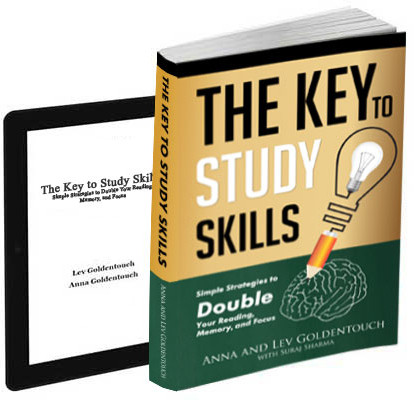
Reading about visualization and creative markers is only the first step. Real transformation happens when these techniques are applied systematically, practiced correctly, and reinforced over time. That is exactly what The Key to Study Skills (2nd Edition): Simple Strategies to Double Your Reading, Memory, and Focus is designed to do.
The book takes you beyond isolated tips and introduces a complete, structured learning system, one that shows you how to read faster without losing understanding, remember information long-term, and stay mentally focused even with complex material. Every strategy is built to work with your brain’s natural learning mechanisms, not against them.
To accelerate your progress even further, the KeyToStudy: Memory Masterclass provides guided training that helps you turn these principles into real-world skills. Instead of guessing whether you’re doing it right, you follow a clear framework that strengthens visualization speed, marker accuracy, and creative recall, step by step.
Whether you are a student, professional, or lifelong learner, this combination of book and course equips you with tools you can use for years, across subjects, careers, and personal goals.
📩 Contact us at [email protected] to receive exclusive discounts on the KeyToStudy: Memory Masterclass and start building a sharper, faster, and more reliable learning system today.
Your ability to learn is not fixed. With the right methods, it becomes your greatest competitive advantage.

Get 4 Free Sample Chapters of the Key To Study Book
Get access to advanced training, and a selection of free apps to train your reading speed and visual memory