
In an age where information is abundant but attention is scarce, many learners struggle not because they lack intelligence, but because they lack an effective system. Reading feels slow, memory feels unreliable, and focus breaks under pressure. This is exactly the problem addressed in my book, The Key to Study Skills (2nd Edition): Simple Strategies to Double Your Reading, Memory, and Focus.
The KeyToStudy System explains who this approach is designed for, why conventional study methods often fail, and how continuous improvement, visualization, memory, speedreading, and analysis work together as a unified learning framework. Rather than offering isolated techniques, it presents a complete philosophy, one that adapts to different ages, professions, languages, and cognitive styles.
This article presents that framework as a single, cohesive overview, preserving every essential concept while remaining clear, practical, and accessible.
The Real Problem: Gaps, Not Intelligence
Many learners assume that difficulty with reading or memory reflects a personal limitation. In reality, the issue is usually structural. Education often develops depth in narrow areas while leaving significant gaps elsewhere. These gaps may not be immediately apparent, but they become evident when learners encounter unfamiliar domains, dense texts, or large volumes of information.
The KeyToStudy philosophy reframes this challenge. Gaps in knowledge are not failures; they are natural outcomes of selective learning. What matters is having a systematic way to return, rebuild, and integrate missing foundations when the need arises. Learning is not linear, and no single method works equally well across all stages of life or types of material.
This insight leads to a critical principle: reading strategies must evolve as life demands evolve. Academic study, professional research, and lifelong learning all require different balances of speed, depth, and retention.
Getting Better at Getting Better: The Kaizen Principle
At the heart of the KeyToStudy System is the concept of continuous improvement, inspired by the Japanese philosophy of kaizen, which means “change for the better.”
Kaizen rejects dramatic, unsustainable transformations in favor of small, consistent improvements that compound over time. Applied to learning, this means focusing on processes, not heroic effort.
The Six-Step Cycle of Continuous Improvement
The KeyToStudy approach applies kaizen through a repeatable learning loop:
- Standardize – Create a clear, repeatable process for a learning task.
- Measure – Track performance using concrete metrics such as time, retention, or comprehension.
- Compare – Evaluate whether the process meets your actual needs.
- Innovate – Search for smarter, more efficient ways to achieve the same result.
- Repeat – Reapply the cycle with refinements.
This cycle transforms learning from a vague intention into an engineered skill. Progress becomes visible, measurable, and motivating.
Motivation Before Method
An often-overlooked element of effective learning is the need for change. The KeyToStudy System emphasizes that motivation does not come from technique alone. It comes from clearly identifying:
What skill or knowledge will produce the greatest improvement in well-being, understanding, or contribution with the least wasted effort?
Unfocused learning leads to overload and discouragement. Focused learning, driven by a clear reason for change, creates momentum.
Equally important is the go / no-go decision during implementation. Before investing energy, learners are encouraged to ask whether the outcome justifies the effort. If the answer is yes, consistent implementation becomes a personal obligation rather than a struggle.
What Is the KeyToStudy System?
The KeyToStudy System is not a single skill; it is a coordinated framework of mutually reinforcing abilities. Each component strengthens the others, and isolating one at the expense of the rest reduces overall effectiveness.
1. Getting Things Done While Learning
Learning is only valuable when it produces results. Students are guided to:
- Set clear learning goals
- Apply skills immediately
- Practice consistently despite limited time
Hands-on application is prioritized over abstract theory. Skills are developed together, not in isolation.
2. Visualization: The Foundation of Speed and Memory
The brain processes visual information significantly faster than verbal input. The KeyToStudy System uses visualization as the primary encoding mechanism for learning.
Concepts are transformed into mental images, markers, maps, or symbolic representations that the visual cortex can process efficiently. Visualization may be conscious or subconscious, but its role is central; it enables both memory formation and reading acceleration.
3. Memorization for Real Life, Not Competitions
The system does not train memory athletes. Instead, it adapts mnemonic principles to practical needs:
- Remembering textbooks
- Retaining professional material
- Organizing functional knowledge
Techniques such as chunking, memory palaces, and PAO (Person–Action–Object) systems are applied selectively, ensuring that memory supports understanding rather than replacing it.
4. Speedreading as a Natural Outcome
Speedreading is introduced only after visualization and memory are strengthened. This sequencing is intentional.
Reading speed is limited not by eye movement, but by how quickly the brain can process and store information. Once processing capacity increases, speedreading becomes both effective and necessary, especially in a digital world dominated by articles, reports, and online content.
5. Analysis and Critical Thinking
Trying to remember everything is counterproductive. Advanced learning requires judgment.
Key analytical skills include:
- Adapting strategy to material
- Using prior knowledge
- Prioritizing information
- Designing a personalized learning approach
Analysis ensures that learning remains purposeful and applicable.
6. Community and Collective Growth
Learning accelerates when supported by others. The KeyToStudy System places strong emphasis on community, mentorship, and shared problem-solving. Collaboration allows learners to compensate for individual differences while maintaining accountability and momentum.
Why the System Works
The effectiveness of the KeyToStudy System lies in active mental engagement. Instead of passive reading, learners interact with material through imagery, structure, and association. This creates multiple neural pathways for the same information, dramatically improving retention.
The system is also adaptable. Visual learners, analytical thinkers, and repetition-based learners can all emphasize different elements while staying within the same framework.
Small wins, such as improved recall or faster comprehension, build confidence early. These incremental successes generate a self-reinforcing cycle of motivation and progress.
A Scientific Foundation, Not Guesswork
The techniques in the KeyToStudy System are grounded in established cognitive principles, including:
- Dual coding
- Metacognition
- Chunking
- Spatial memory
- Subvocalization control
- Information theory
- Critical analysis and ontology
Rather than relying on isolated studies or exaggerated claims, the system integrates methods that align with how the brain naturally processes information.
Who the KeyToStudy System Is For
The system is designed for learners aged 13 to 65 who read and learn regularly. Emphasis shifts with age, creativity for younger learners, memorization and analysis for older ones, to prevent stagnation and burnout.
It is also adaptable for:
- Bilingual learners, who must retrain their speed-reading skills for each language
- Professionals such as programmers, lawyers, doctors, and analysts
- Learners with ADHD or dyslexia, who may require more creativity or effort, but can still achieve remarkable improvements
Personalization is encouraged, and guidance is available for those with specific challenges.
Common Misconceptions Addressed
Several persistent myths are addressed directly:
“Speedreading reduces comprehension.”
Up to a point, increased speed actually improves focus by preventing mind wandering.
“I tried other courses and failed.”
Speedreading without memory training is ineffective. Processing capacity must come first.
“This isn’t useful for my work.”
Any role involving daily reading benefits from faster processing, better recall, and clearer analysis.
The real limitation is rarely ability, it is inconsistent practice or unfocused effort.
Training Schedules: What Works and What Doesn’t
Effective learning requires balance. Common mistakes include cramming, overtraining, combining incompatible methods, or replacing reading with games.
Progress depends on consistent reading, gradual skill layering, and allowing time for mental adaptation. Learning is cumulative, not compressible.
Where Better Reading and Memory Begin
Learning challenges are rarely solved by shortcuts or willpower alone. They are solved through structure, proven processes, and smart adaptation. That’s exactly why the KeyToStudy System exists: to give you a clear, practical way to read faster, remember more, and think with confidence in today’s information-heavy world.
The Key to Study Skills (2nd Edition): Simple Strategies to Double Your Reading, Memory, and Focus brings this system together in one complete, easy-to-follow framework. Inside, you’ll discover how visualization, memorization, speedreading, and analysis work in harmony to transform the way you study, work, and learn for life.
If you’re serious about upgrading your learning skills, whether for exams, professional growth, or personal development, this system was built for you.
Discover the complete framework in the book:
The Key to Study Skills (2nd Edition): Simple Strategies to Double Your Reading, Memory, and Focus
Want guided, hands-on training?
Take the next step with the KeyToStudy: Memory Masterclass and apply these principles step by step with structured guidance.
Get exclusive course discounts.
Contact us at [email protected] and ask about available offers.
Learning isn’t about trying harder; it’s about using the right system and letting it work for you.

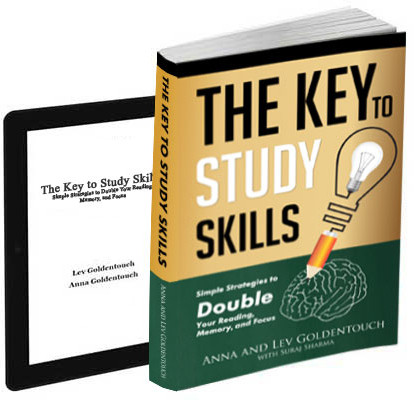
Get 4 Free Sample Chapters of the Key To Study Book
Get access to advanced training, and a selection of free apps to train your reading speed and visual memory