We have students of all ages. Our intelligence changes with age, and what works for one age will not necessarily work for another. Typically our course works well for ages between 13 and 65, however it can be easily adapted for wider age ranges. Before age of 13 kids simply do not read fast enough …
KeyToStudy Offers:
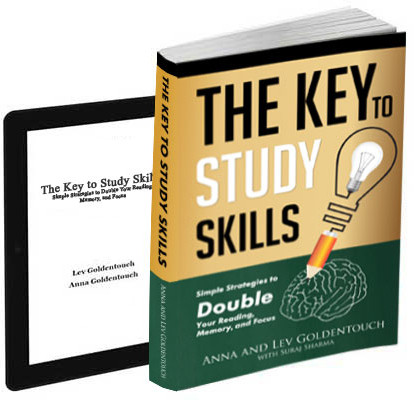
Memory, Speedreading, and Analysis
KeyToStudy Overview:
Memory, Speedreading, and Analysis
ProlificFocus Overview:
Productivity, Motivation, and Projects
ProlificFocus Offers:
Productivity, Motivation, and Projects
Building timeline and visualizing history
A very small percentage of people (~2%) is born with extremely good autobiographic memory: they remember every student in their class and every event of their life. Yesterday I met some classmates whom I have not seen for 26 years. Some things remained the same, but one thing that changes was my perception of childhood. …
Continue reading “Building timeline and visualizing history”
Mnemonic major system
The mnemonic major system is quite ancient. In its most pure form, each number is a letter and letters form words that can be easily remembered. Ancient alphabets and new champions When we consider the Hebrew alphabet, each letter is a number, and Kabbalah is using this to achieve miraculous deeds. In Hindu there is …
Memory palaces
Memory palace/loci is the oldest method available for memorization, and still it feels like we are very far from using its full potential. If you are interested using memory palace for any specific application, I suggest you to try Anthony Metivier’s books. Anthony has demonstrated how memory palaces can be used virtually for anything with …
Mindmapping
So far I have referenced Tony Buzan books for mindmapping. I am realizing that I need to give my students a short and useful explanation of how to use mindmapping and why. This post is intended to be useful, so I will not go into historical, classical and programmable aspects of mindmapping, but focus on …
Superlearning for languages and definitions: etymology method
Very often I ask students to understand the meaning of what they are trying to learn and use very accurate markers. I want to demonstrate it on etymology. Take for example this real conversation: EY: I can create images to the words in the dictionary (some easier than others), but my main problem is that …
Continue reading “Superlearning for languages and definitions: etymology method”
PAO memory technique
PAO is one of the most advanced and yet fun to use techniques. PAO means person-action-object. It is commonly used in memory championships. As far as I know (could not find a link) PAO was invented by card-counters. Each card face was associated with personality – Kings, Queens, Princes – and even with specific royalty …
Advanced memorization systems and memory sports
Superlearning or speedreading are hard to measure and monitor. Memory is easily measurable, and therefore memorization skills are a sport. The best thing about sports is our ability to learn which methods work better than others to remember a huge amount of information. Moreover, as sport develops, the methods become increasingly elaborate. Memory palace/loci. This …
Continue reading “Advanced memorization systems and memory sports”
Superlearning for programmers: algorithm development
My first job was database administrator. My second job was an RF engineer. My third job (back in 1999) was under title “algorithm developer”, and that was the first job I really loved. Since then I have been algorithm developer/CTO on and off, dealing with computer vision, image procession, machine learning, financial mathematics, semantic processing, …
Continue reading “Superlearning for programmers: algorithm development”
Superlearning for programmers: code maintenance
There are many ways speedreading can help a programmer. The first time I wished I could speedread was back in he year 2000, when I had to maintain a code of 1mil lines. Back then I could not speedread, and eventually could not fix all the problems I made in time. The product did not …
Continue reading “Superlearning for programmers: code maintenance”